
How a Lawn Mower Fuel Pump Works
This post contains affiliate links. As an Amazon Associate, we earn from qualifying purchases.
Your lawn mower sputters to life, then dies after three seconds. You check the gas tank—it’s half full. The air filter looks clean. What’s the invisible culprit? For most walk-behind and riding mowers, the answer hides in that small black box bolted to the engine block: the fuel pump. Unlike car fuel systems, 90% of lawn mowers rely on mechanical pumps that harness the engine’s own breathing to move gas uphill from tank to carburetor. When this pulse-driven system fails, your mower starves for fuel even with fresh gasoline. In the next few minutes, you’ll discover exactly how these rugged little components convert crankcase pulses into reliable fuel delivery, spot failure symptoms before they strand you mid-mow, and learn the 15-minute maintenance trick that prevents most pump-related breakdowns.
Engine Vacuum Pulses Power Diaphragm Action
Crankcase Creates Rhythmic Fuel Pumping Motion
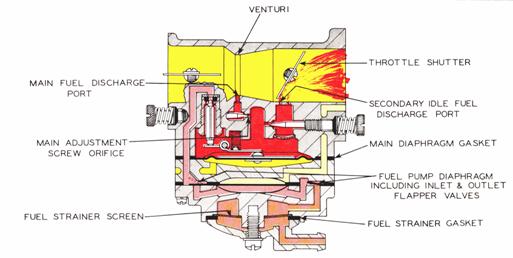
Every piston stroke in your mower’s engine generates invisible pressure waves. During the downstroke (intake cycle), the piston creates a vacuum of -2 to -5 psi inside the crankcase. On the upstroke (compression cycle), it pushes out positive pressure of +2 to +5 psi. These alternating pulses travel through a dedicated ¼-inch pulse line to the fuel pump. At 3,000 RPM, that’s 3,000 precise fuel-pushing motions per minute—no electricity required. The pump essentially “rides” these engine-generated waves to maintain steady fuel flow.
Diaphragm Flex Transfers Energy to Gasoline
Inside the pump sits a critical component: a flexible rubber diaphragm just 0.4 mm thick. When crankcase vacuum hits the pulse chamber, it pulls this diaphragm inward 1-3 mm, expanding the fuel chamber and creating suction. Then crankcase pressure snaps it back, compressing the fuel chamber to push gasoline toward the carburetor. This single flexible membrane handles all the work—no gears or rotors—moving 0.3-1.0 cc of fuel per stroke. Its thin, fuel-resistant polymer construction withstands ethanol blends while maintaining perfect seal integrity during thousands of daily flex cycles.
Check Valves Ensure One-Way Fuel Flow
Two tiny one-way valves prevent backflow and maintain directional flow. The inlet check valve (typically a brass seat with neoprene flap) opens only when the diaphragm pulls back, allowing tank fuel to fill the chamber. Simultaneously, the outlet check valve snaps shut to block reverse flow. When the diaphragm pushes forward, the inlet valve slams closed while the outlet valve opens, sending pressurized fuel toward the carb. These valves tolerate less than 0.5 mL/min of leak-back at 0.5 psi reverse pressure—any more and your engine floods or starves.
Three-Hose System Keeps Fuel Moving Uphill
Tank Fuel Line Must Stay Unobstructed
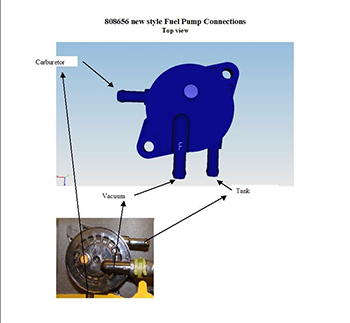
The first barbed nipple connects directly to your fuel tank via a clear vinyl or rubber hose. This inlet line must remain completely straight and unobstructed—any kink or clogged in-tank filter instantly starves the pump. Ethanol-blended fuels accelerate deterioration here, causing rubber hoses to swell and crack internally. Always replace this line if you spot cloudiness or stiffness, as microscopic debris can destroy the pump’s delicate check valves.
Carburetor Delivery Line Requires Precise Pressure
The second nipple feeds gasoline to your carburetor’s float bowl at a critical 0.5-1.5 psi pressure. This low pressure prevents flooding while ensuring reliable delivery, even when mowing steep slopes. Higher pressure would overwhelm the carburetor’s needle valve, causing raw fuel leaks. If you disconnect this line during testing, expect a steady 1+ cm fuel squirt with every engine revolution—less indicates diaphragm failure or valve issues. Never use standard automotive fuel line here; it can’t withstand ethanol’s swelling effect.
Pulse Line Is the Engine’s Fuel Pump Trigger
The third hose—smallest of the three—is your pump’s lifeline. This ¼-inch pulse line carries crankcase pressure waves that actually drive the diaphragm. Even a pinhole leak here kills pump function because it breaks the vacuum seal. Always inspect this hose for soft spots or cracks near clamps, as engine heat degrades rubber fastest at connection points. When replacing, use only collapse-resistant pulse line (marked “fuel pulse” or “crankcase”)—standard vacuum hose buckles under pressure cycles.
Electric Fuel Pumps Replace Pulses with Power
Modern Engines Use Constant-Pressure Electric Pumps
Newer Kohler EFI, Kawasaki FR series, and premium residential mowers increasingly use electric impeller pumps. Triggered by your ignition switch, these run at constant 3,000-4,000 RPM regardless of engine speed. They deliver higher, steadier pressure (2-4 psi) through an internal relief valve that bypasses excess fuel back to the tank. Unlike mechanical pumps, they prime instantly when you turn the key—no need to pull the starter cord repeatedly.
Electric vs. Mechanical: Critical Differences
- Electric pumps cost $15-$40 and excel on steep terrain but require 12V wiring, fuses, and relays that can fail
- Mechanical pumps ($8-$15) work without electricity but struggle on slopes over 15 degrees
- Both deliver 10-40 L/h flow—far more than needed for small engines—ensuring ample fuel during heavy cutting
Gravity Feed Eliminates Pumps on Some Models
Top-Mounted Tanks Use Natural Fuel Flow
Walk-behind mowers with fuel tanks positioned at least 2 inches above the carburetor float bowl skip the pump entirely. Gravity alone creates sufficient 0.3-0.5 psi pressure for reliable fuel delivery. This explains why some mowers have only a single fuel line running straight from tank to carburetor. If your tank sits lower than the carb (like most riding mowers), you absolutely need a pump—gravity simply can’t push fuel uphill.
Instant Visual Identification Method
Peek under your mower’s hood: A single fuel line = gravity feed system. A small rectangular block (about 2×1.5 inches) with three hoses = mechanical pulse pump. A cylindrical canister with wires and two fuel nipples = electric pump. This 5-second check tells you exactly which system you own before troubleshooting.
Diagnose Fuel Starvation in 60 Seconds
Start With Tank Vent and Fuel Freshness
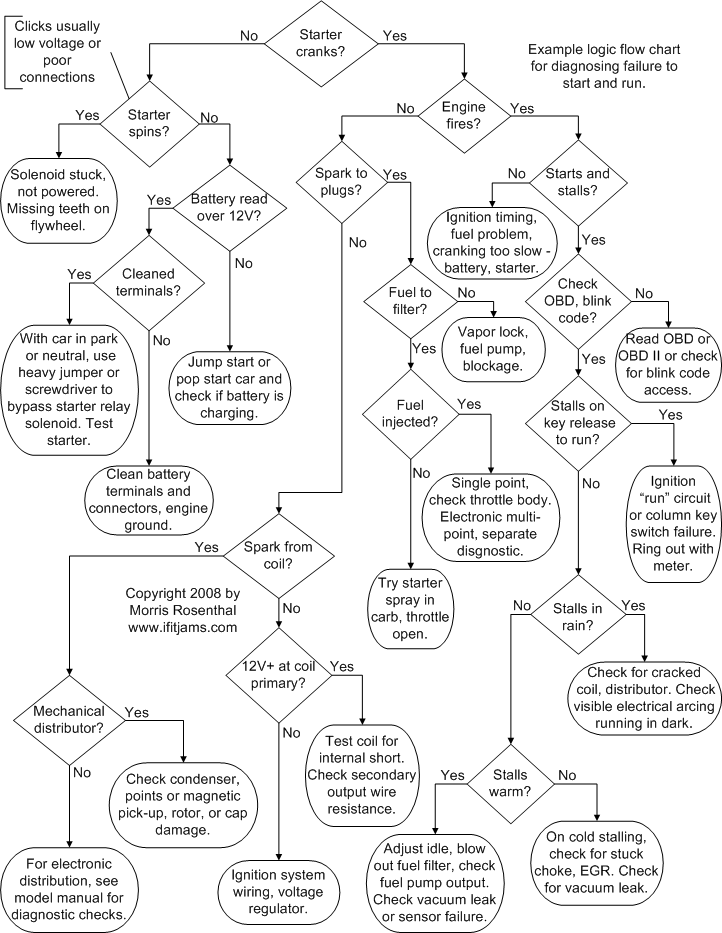
Before touching the pump, confirm you have ≥½ tank of gasoline less than 30 days old. Old fuel forms varnish that clogs passages. Then remove the gas cap—listen for a hiss indicating a blocked vent. A vacuum-locked tank mimics pump failure by starving the engine after 30 seconds of operation. Reinstall the cap loosely; if the mower runs normally, replace the vented cap immediately.
Pulse Line Test Reveals Engine Health
Pull the pulse hose off the pump and cover the end with your fingertip while cranking the engine. You should feel strong, rhythmic suction pulses matching engine revolutions. Weak or absent pulses indicate worn crankcase seals or internal engine damage—not a pump problem. This test separates pump failures from deeper engine issues.
Fuel Flow Test Confirms Pump Function
Disconnect the outlet hose at the carburetor and crank the engine. Healthy mechanical pumps deliver a 1+ cm fuel squirt with every revolution. No flow means a torn diaphragm or stuck valves. For electric pumps, listen for a 2-3 second whirring sound when turning the key—if silent, check fuses and wiring before assuming pump failure.
Prevent Pump Failures With Simple Maintenance

Seasonal Care That Avoids 90% of Breakdowns
- Replace the inline fuel filter every 50 hours or before spring startup
- Use ethanol-free fuel or add stabilizer to prevent diaphragm swelling
- Drain the tank and carburetor for storage over 30 days
- Inspect pulse lines annually for cracks—replace if spongy when squeezed
Pump Replacement Done Right in 8 Steps
- Run engine until it stalls to depressurize the system
- Label inlet, outlet, and pulse hoses before disconnecting
- Remove two mounting screws (typically ¼-20 or 5mm)
- Note gasket position—paper or rubber, never reuse
- Install new pump with correct port alignment (inlet toward tank)
- Torque screws to 20-25 in-lbs—overtightening cracks housings
- Reconnect all hoses with fresh clamps ½ inch from fittings
- Prime with 3-4 starter pulls and check for leaks at 15-second intervals
Recognize Failure Patterns Before They Strand You
Torn Diaphragm: Sudden Power Loss
Symptoms include fuel leaking from the pump body or engine starting then immediately dying. Ethanol exposure causes rubber diaphragms to swell and crack over time. Unfortunately, no rebuild kits exist—replace the entire pump. Always carry a spare ($10-$15) if you mow large properties where breakdowns mean long walks home.
Stuck Check Valves: Surging and Hesitation
When debris jams the tiny inlet or outlet valves, your mower surges at idle or loses power under load. Tap the pump body firmly with a screwdriver handle—a temporary fix if valves are merely sticky. Persistent issues require pump replacement, as cleaning rarely restores the critical <0.5 mL/min leak-back tolerance.
Cracked Pulse Hose: Slope-Specific Stalling
This sneaky failure causes intermittent stalling only when mowing hills. The crack opens under vibration on inclines, breaking the vacuum seal. Replacement costs under $2 and takes 5 minutes—keep spare pulse line in your mower toolbox. Always pinch the hose while running; if engine smooths out, you’ve found the culprit.
Engine Brand Pump Reference Guide
- Briggs 450-550EX: Mechanical pump (p/n 808656), $9-14, 25mm port spacing
- Honda GCV160/190: Carb-integral pump (p/n 16700-Z0L-013), $12-18
- Kawasaki FR/FS: Electric in-tank (p/n 49040-7004), $45-65, requires 5A fuse
- Kohler Courage: Mechanical pulse (p/n 24-393-16-S), $10-15, common on John Deere tractors
Final Takeaway: Master Fuel Flow Fundamentals
Whether your mower uses the century-old pulse-diaphragm system or modern electric pumps, their mission remains identical: deliver clean fuel from tank to carburetor under precisely controlled low pressure. By understanding the three-hose plumbing system, recognizing the rhythmic “heartbeat” of a healthy mechanical pump, and performing that critical annual filter swap, you’ll solve 90% of fuel-related issues without professional help. Remember this golden rule: When your mower starves for fuel, always test the pulse line before replacing parts—it separates true pump failures from simple vacuum leaks. Keep this guide in your shed, and you’ll never waste another mowing day diagnosing fuel starvation.
